My Top 15 Elements for Successful Bible Study – YouVersion Mobile Bible

As we grow in our walk with Christ, knowing God’s word (and seeking it with zeal) is one of the most important things we can do.  After all, he’s revealed himself to us in two primary ways: Through his Holy Spirit, which we received as a gift when we became Christians, and in his Word.

This post is the third of 15.  In each post, I’ll be examining my personal “Top 15″ things leading to successful bible study.  I want to be clear that this may not be your top 15.  But I’ve observed that over the last six months, all of these things play an important role in my spiritual journey.  Maybe a few of them will be valuable for you, too.

Click the link to view Tuesday’s post on Study Bibles.
Source Materials – the YouVersion Mobile Bible.  I’ve used the YouVersion bible for iPhone for a couple of years now, and it just keeps getting better and better.  I always found it a little challenging to carry a bible to church when we had little kids (and were pushing strollers, carrying bags, holding hands etc).  Now, I don’t have to … because I’ve got dozens of translations in my iPhone.
This app is indispensible for study, if only because it’s always with me, and allows me to flip between tranlations whenever I need to.  The latest version also allows you to:
  • download various translations to your iPhone, so you don’t have to worry about having a 3G/WiFi connection
  • bookmark passages for later study
  • add study notes per passage
  • share verses through Facebook and twitter
  • opt to listen to passages read in a lovely English accent for most translations
As you can see from the previous posts, I haven’t given up my paper-and-ink bibles, but if you have a smartphone, this is a no-brainer for you to add your collection.  And now that I have gotten an iPad, I’m using it more and more.


My Top 15 Elements for Successful Bible Study – Study Bible

As we grow in our walk with Christ, knowing God’s word (and seeking it with zeal) is one of the most important things we can do.  After all, he’s revealed himself to us in two primary ways: Through his Holy Spirit, which we received as a gift when we became Christians, and in his Word.

This post is the second of 15.  In each post, I’ll be examining my personal “Top 15” things leading to successful bible study.  I want to be clear that this may not be your top 15.  But I’ve observed that over the last six months, all of these things play an important role in my spiritual journey.  Maybe a few of them will be valuable for you, too.

Click the link to view yesterday’s post on The Message.
Element number two: A good Study Bible.
Bible – New Living Translation (Life Application Study edition).  Having a study bible is a really good idea; the important things for me to find were:
  • A translation that made sense to me from a readability perspective
  • Reference notes to other relevant scriptures in each margin
  • Forewards to each book of the bible establishing authorship, historical content and key themes
  • Footnotes for translation issues
  • Study notes for important passages
I found what I was looking for in Zondervan’s New Living Translation Study Bible.  This bible also includes many historical maps (e.g., Paul’s missionary journeys), timelines, and analyses of key themes.  While those features aren’t absolutely necessary, they are incredibly handy.  When studying the new testament, I usually read the message first, and then follow up with the NLT to make sure I’m not falling pray to an overly liberal translation in the former.
One note: It’s really useful to buy a study bible translation that matches up with your church or study group’s primary translation.  I DIDN’T do that, and I have often regretted it.  My old church (Southeast Christian in Louisville, KY) used the New International Version.  I was in a study group there (Discipleship Curriculum) for two years and memorized over 100 passages from scripture … in a version that was different from my primary bible.  It was a pain, and often confusing.  My current church (the Austin Stone Community Church in Austin, TX) seems to use the English Standard Version primarily, so I’m out of luck there as well.  I generally prefer the NLT to either of those versions, but the multiple-translation issue isn’t worth the headaches it causes.  My advice: Give your church a call and ask which translation they use most frequently, and go with that one.
Tomorrow’s Post: YouVersion Mobile

My Top 15 Elements for Successful Bible Study – The Message

It’s taken years, but I have finally gotten into a nice rhythm in terms of studying the bible.  As we grow in our walk with Christ, knowing God’s word (and seeking it with zeal) is one of the most important things we can do.  After all, he’s revealed himself to us in two primary ways: Through his Holy Spirit, which we received as a gift when we became Christians, and in his Word.  My morning prayer almost always ends with David’s plea from Psalm 119: “I have hidden your word in my heart that I might not sin against you.”
This post is the first of 15.  In each post, I’ll be examining my personal “Top 15” things leading to successful bible study.  I want to be clear that this may not be your top 15.  In fact, this list might not be applicable to another person on earth.  But I’ve observed that over the last six months, all of these things play an important role in my spiritual journey.  Maybe a few of them will be valuable for you, too.
I’ve divided these elements into 5 categories; the first of them being Source Materials (Bible study has to start with a bible!).  And source material number one, for me, is The Message.

Bible – The Message.  You could argue about the importance or priority of many of the items on this list … but it’s pretty obvious that if you’re going to study the bible, you’ve got to start with the source materials: The bible itself.  It might be that you find a single translation or bible that works for you; I actually haven’t found a translation that works for me at the exclusion of all others.  I have to confess that I wrestled with putting The Message number one on my list.  After all, it’s only the New Testament!  However, I study the bible primarily so that I can know the person, character and example of Christ.  And I don’t just want to know him in an academic sort of way; I want to know him as my best and most loyal friend.  The Person who gave up everything – in a way that stretches the very meaning of that word – so that I could know my Creator and spend eternity with him.

Because The Message is written in modern vernacular, it feels much more personal and relevant to me.  It speaks to me the way a friend would.  And because of that, it touches my heart and my mind in a way that no other translation does.  I will note, however, that The Message seems to be a pretty liberal translation.  That’s why my general practice is to read every passage twice: First in The Message; then in my New Living Translation study bible.

Element number two comes tomorrow: The New Living Translation Study Bible.

Are you God’s man? Or a law man?

No Dancing!

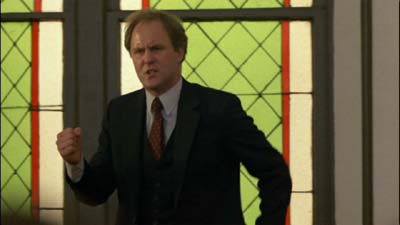
For most of my life, I believed that being a Christian was mostly about following rules.  And that those rules were primarily about stuff you weren’t supposed to do.  It’s not too surprising, really.  If you asked 100 random Americans what it means to be a Christian, they’d probably have several “don’t do X” in their responses.

And that isn’t surprising either.  The church has consistently supported this thinking by making its most visible public statements about things that people ought not to do.  Don’t drink.  Don’t dance. Don’t _____ (fill in the blank with your favorite “don’t.”)

IMPORTANT NOTE: I’m not saying that there aren’t thousands (millions?  Gajillions?) of things that we can do that are displeasing and dishonoring to God.  But I am saying that when all the public sees of us is a series of DON’Ts, it’s logical to assume that Christianity is really about following the rules.  IT ISN’T.

It is about loving God with all your heart, soul and strength.  It is about loving your neighbor as much as  yourself.  It is about loving and serving all.  Including – no, especially – your enemies.  It is about living like Jesus did.

What struck me during my bible study today is that this has been an issue since the beginning of the church.  Paul, in his letter to the Galatians, summed up the issue like this:

I tried keeping rules and working my head off to please God, and it didn’t work. So I quit being a “law man” so that I could be God’s man. Christ’s life showed me how, and enabled me to do it. – Galatians 2:19-20, The Message.

I’ve been trying to think about how I can show the people around me – through my words and my actions – what Jesus was like.  How loving he was – to people who were “unloveable.”  How he came to serve.  How he enabled people to change from the inside – and not by the force of law.

God’s law provides guidance for us, and shows us how to live his way.  As Paul said,

But I can hear you say, “If the law code was as bad as all that, it’s no better than sin itself.” That’s certainly not true. The law code had a perfectly legitimate function. Without its clear guidelines for right and wrong, moral behavior would be mostly guesswork. Apart from the succinct, surgical command, “You shall not covet,” I could have dressed covetousness up to look like a virtue and ruined my life with it. – Romans 7:7, The Message

We are fools if we ignore the law.  But we are greater fools if we mistake God’s law for God himself.  I, like Paul, want to be God’s man – not a “law man.”

Puritan Prayer – the Valley of Vision

I’ve always had a fairly negative view of the group of people we call generically “The Puritans.”  I imagine that my negativity stems from highly publicized events such as the Salem Witch Trials, but I also think that it’s probably also colored by our society’s view of Puritans as hypocritical repressors.  In some ways, all most of us know about Puritans, we learned in The Scarlet Letter – a book that certainly doesn’t paint a very positive picture.

However, from time to time at the Austin Stone, either the pastors or one of the worship team will read a passage from a book called Valley of Vision.  It’s a book of collected Puritan devotions from authors primarily in the 1600s and 1700s in France, Holland, England and America, edited by Arthur Bennett, an English pastor.  And whatever shortcomings – real or perceived – may remain in my consciousness, I can say that the prayers they prayed were remarkable.  Deep, thoughtful and beautiful, I find them completely relevant to my spiritual journey, though they were written in a much different time and place.  I typically close my morning bible study with a reading from Valley of Vision … Below is an excerpted example that moved me as I read it this morning.

O Holy Spirit,
As the sun is full of light,
the ocean full of water,
Heaven full of glory,
So may my heart be full of thee.
Vain are all divine purposes of love
and the redemption wrought by Jesus
except thou work within,
regenerating by thy power,
giving me eyes to see Jesus,
showing me the realities of the unseen world.
Give me thyself without measure,
as an unimpaired fountain,
as inexhaustible riches.
I bewail my coldness, poverty, emptiness, imperfect vision, languid service, prayerless prayers, praiseless praises.
Suffer me not to grieve or resist thee.
Come as power,
to expel every rebel lust, to reign supreme and to keep me thine;
Come as teacher,
leading me into all truth, filling me with all understanding;
Come as love,
that I may adore the father and love him as my all;
Come as joy,
to dwell in me, move in me, animate me;
Come as light,
illuminating the scripture, moulding me in its laws;
Come as sanctifier,
body, soul and spirit thine;
Come as helper,
with strength to bless and keep, directing my every step;
Come as beautifier,
bringing order out of confusion, loveliness out of chaos
Magnify to me they glory by being magnified in me,
and make me redolent of thy fragrance.
– Spiritus Sanctus, The Valley of Vision

Reading works like that tells me that there is much more to the dour, hypocritical repressor in the heart of the Puritan … and makes me want to learn more about my spiritual forebears.

When the world rejects you

No Christians Here

We know that true Christians are to suffer the fate of Christ … to be mocked and spurned by the world. But in modern America, we’re seldom burned at the stake or fed to lions.  So I’ve often thought that Christian persecution looks very different in 21st century America than in almost any other place or time. But reading First Corinthians this morning made me wonder if we’re really in such a different position than those in the early church.

10 We are fools for Christ, but you are so wise in Christ! We are weak, but you are strong! You are honored, we are dishonored! 11 To this very hour we go hungry and thirsty, we are in rags, we are brutally treated, we are homeless. 12 We work hard with our own hands. When we are cursed, we bless; when we are persecuted, we endure it; 13 when we are slandered, we answer kindly. We have become the scum of the earth, the garbage of the world—right up to this moment. (1 Corinthians 4:10-13, New International Version, ©2011)

Paul was admonishing the early church at Corinth, who felt so “wise in Christ,” that they were lording that presumed wisdom over others, and using it to one-up each other by associating themselves with factions  in the church (in this case, the “Paul Faction” vs. the “Apollos Faction.”)

I was recently snubbed by a friend who told me that he “couldn’t stand all of (my) religious crap.”  And I was really torn about how to feel.  On the one hand, it’s to be expected: When we try to represent Christ and live the way he intended us to, we will be snubbed and mocked (if not worse).

18 For the message of the cross is foolishness to those who are perishing, but to us who are being saved it is the power of God. (1 Corinthians 1:18, New International Version, ©2011)

But that view may be too simplistic.  Paul’s message to the Corinthian church is a reminder that, especially in a society where Christianity is upheld (at least on the surface), we’re just as likely to be perceived as pharasaical “moral police,” who are spouting their wisdom just like the Corinthians.  Am I truly living like Christ did?  Or like Paul?  Am I humbling myself and serving others?  Loving and praying for my enemies?

I don’t mind being mocked or cast aside for Christ.  And I expect to be rejected by “the world” – by modern secular culture.  But I need to be sure it’s because I’m really acting like Christ – and not like a Corinthian.

Scared to Death of Evangelism?

Scared to Death?

I’ve never been great at sharing the gospel with others. There have even been times when people have asked me questions about my faith, and I’ve given pathetic answers that I regretted later. Of course, there are answers for that … prayer and study significant among them. But there’s another, more important answer: Trust that God is working in those around me, shaping their ears to hear and their hearts to believe. I was reminded of that this morning when reading my REAP passage from Paul’s first letter to the church at Corinth:

1-2You’ll remember, friends, that when I first came to you to let you in on God’s master stroke, I didn’t try to impress you with polished speeches and the latest philosophy. I deliberately kept it plain and simple: first Jesus and who he is; then Jesus and what he did—Jesus crucified.

3-5I was unsure of how to go about this, and felt totally inadequate—I was scared to death, if you want the truth of it—and so nothing I said could have impressed you or anyone else. But the Message came through anyway. God’s Spirit and God’s power did it, which made it clear that your life of faith is a response to God’s power, not to some fancy mental or emotional footwork by me or anyone else. (1 Corinthians 2:1-5, The Message)

It’s important to study the bible and the doctrine of the church. And it’s important to pray for wisdom and discernment, and for God to give you the right words at the right time. But at the end of the day, nothing that you or I can do or say, no matter how well-studied, eloquent or persuasive, is going to change anyone’s heart – only God can do that. I may still be scared to death of evangelism … but so was Paul, and he did pretty well. May that thought give me the confidence to proclaim what I believe!

The church and the social network

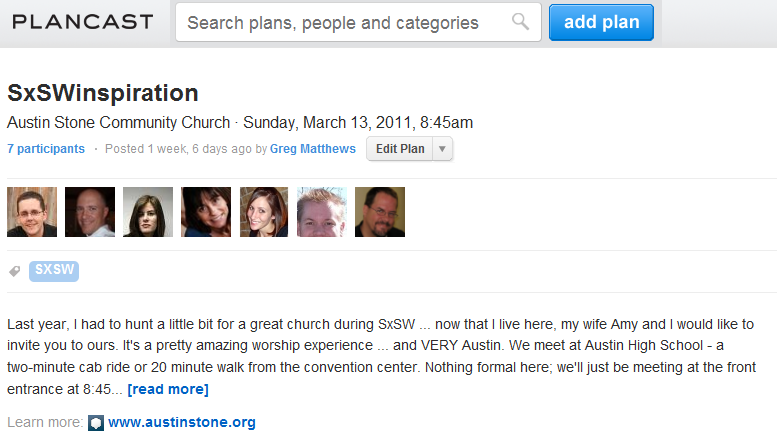
SxSWinspiration on Plancast

Last year at this time, I was attending my second South by Southwest (SxSW) interactive festival – and the first I’d done on my own.  I’d had such an amazing time at the first that I knew I needed to stay for the weekend this time in order to maximize my experience.  I also knew that I didn’t want to miss an opportunity to worship that weekend.  So even though I didn’t know much about any local churches, I did a google search, and wound up finding a church that was just a block from my hotel – and decided to go.  I also, rather at the last minute, invited anyone else from the conference to join me.

An invitation to Austin City Life church

Not surprisingly, nobody took me up on my offer (Sunday morning is not a particularly popular time to be up-and-about at SxSW, as it turns out!).  I had a great time anyway (the thing that left the biggest mark on me was the fact that the church was so strongly oriented to community service), and it planted a seed with me … I wanted to find a way to share Jesus with all of the people at SxSW who’ve shared so much with me.

I eventually moved to Austin (about 2.5 months later, as it turns out), so this year’s SxSW was totally different.  In the weeks leading up to the conference, most of my friends and broader social network connected on Plancast to share our plans for the conference, and to figure out where we were going to meet up.  I figured that would be the perfect mechanism for us to put together an outing to my (now home) church, the Austin Stone.  So I made up a name (SxSWinspiration – a play on SxSWinteractive), created the Plancast invitation you see above, and invited everyone along to the Stone.

I had no idea what would happen … whether 50 people would join me, or zero … one seemed as likely as the other.  The actual result was wonderful … my wife Amy and I wound up playing host to Bryan Person, Mike Neumann, Michelle Batten and Jay Ehret for an amazing message delivered by Pastor Jeff Mangum.  It was wonderful to be together in worship for a short while in midst of all the craziness, and I feel connected to all of those folks in a new way.  Only God knows where we’ll all be next year, but if he’s willing, this will be the first of many years of SxSWinspiration events … see you at the Stone next year!

Red-Letter Christians

Red Letter BibleI know that I have heard the term “red letter Christians” before, but I hadn’t really given a lot of thought as to its origins.  This morning, I discovered to my surprise that I might be one.

The following is excerpted from Eileen Flynn’s “Faith” column in the Austin America Statesman, addressing the question of the “liberal-conservative divide” in today’s church with pastor/sociology professor Tony Campolo:

Older Christians (over the age of 40) still tend to think in terms of categories, such as liberal and conservative. There is a growing movement in America referred to as Red Letter Christianity. It is overwhelmingly a youth movement, and they wish that no labels at all would be used.

But if labels are going to be employed, they reject the older categories that have marked theological debate. Many of these young people studying on secular campuses … find that if they define themselves as evangelicals … their secular colleagues immediately assume that with such a label, they must be married to the right wing of the Republican Party. The word “evangelical” conjures up the popular image of being anti-women, anti-gay, anti-environment, pro-war and connected with the National Rifle Association.

While holding to evangelical beliefs — which include (a) holding to the view of the Bible that deems it inspired by God and hence free from errors; (b) accepting each of the doctrines of the Apostles’ Creed; and (c) holding that salvation comes only through a personal surrendering of one’s life through Jesus Christ, whose sacrifice on the cross delivers from sin — this group of young people is spread across the political spectrum. They do not see that being theologically conservative necessitates political conservatism.

Furthermore, Red Letter Christians are prone to declare that whenever a person uses the Bible to legitimate a humanly created political ideology, that person is guilty of idolatry .– Tony Campolo, in the Austin Statesman on February 12, 2011.  [Emphasis mine]

What isn’t stated explicity here (but will be worthy of more exploration on my part) is that “red-letter christianity” refers to people who anchor their lives to Christ and his teachings.  You see, it was once common to print Jesus’ words in red in the bible.

I don’t know much about Tony Campolo – Ms. Flynn’s article refers to some positions he’s taken as being controversial within the church – but I certainly like and agree with his description of the changing face of the church.  Those are red letters that I will gladly wear on my sleeve.

“Bless You” – The nature of spiritual power

When reading the gospels, I am often struck by the very real nature of the spiritual power that Jesus possessed and passed on to his followers.  In Luke 9, he sent out the 12 apostles to cast out demons and to heal the sick … and in Luke 10, he sent 70 or more out on a similar mission.  In both cases, his followers came back pronouncing success.  What does that power look and feel like?  One of the most visceral passages in scripture describing the nature of this spiritual power occurs in Mark 5.

Jesus is walking through a crowd, and a woman who has suffered for years (emotionally and mentally as well as physically, I would imagine) from constant hemorrhaging reaches out to touch the hem of Jesus’ robe, believing that the single touch could cure her when nothing else could.  She was right; her faith in Jesus did cure her ailment.  But I raise the point because of Jesus’ reaction:

Jesus realized at once that healing power had gone out from him, so he turned around in the crowd and asked, “Who touched my robe?” — Mark 5:30 [emphasis mine]

For whatever reason, I never thought of that power as something that could be stored, or felt, or spent.  And somehow, that makes Jesus’ spiritual power seem more real and tangible to me.  And the reason I’m writing about it today is because of another gospel passage from Luke (my current reading, in case you hadn’t guessed).

In Luke 10, Jesus is preparing to send out a large group of disciples to precede him into Judean towns, preparing the way for him to come and deliver the Good News.  He gives them several instructions about what they’re to do, how they’re to behave and what they’re likely to face.  But his instruction for seeking lodging was particularly interesting:

“Whenever you enter someone’s home, first say, ‘May God’s peace be on this house.’  If those who live there are peaceful, the blessing will stand; if they are not, the blessing will return to you.” — Luke 10:5-6 [emphasis mine]

The way that Jesus words this command, it sounds as if the blessing pronounced by the disciples has the same characteristics as the spiritual healing power Jesus himself manifests in the passage from Mark.  In other words, the blessing of a disciple of Christ is not just a nice, pleasant salutation.  It is a word of power.  God tells us throughout scripture that the prayers of his people are powerful (see James 5:16).  But it is a awesome thing to think that I have the ability to pass God’s blessing to others.

In truth, I have been unable to find any biblical commentaries that support the way I’m reading this message; the closest is from 17th-century pastor and author Matthew Henry [side note: his commentary and many others are built directly into the Blue Letter Bible – an invaluable resource for studying and understanding the bible].

However, this is something that I intend to ponder and pray about – because I do believe that our blessings can have real meaning.  And as I pray, and interact with people through the course of my days, I plan to be very intentional about asking for God’s blessings on them and various aspects of their lives.  Jesus tells us that if we have faith, we can move mountains … And by my faith in sharing God’s real blessing with others, those blessings have great power.

[Author’s Note: I feel that there is unusually high risk of this post being misinterpreted, but I am planning to share it anyway because it’s on my heart to do so.  I want to be very clear that I am in no way intending to glorify myself as a result of having some kind of magical ability.  In fact, Jesus cautioned his disciples in the same way as they returned from their mission: “All the same, the great triumph is not in your authority over evil, but in God’s authority over you and presence with you. Not what you do for God but what God does for you—that’s the agenda for rejoicing.” Luke 10:18-20 – The Message]

Praying image courtesy of Christians Concerned for the Community of Gainesville, Florida